How to Find Your School Catchment in WA
Every Perth parent ends up Googling this exact phrase at some point, usually right after a real-estate listing mentions a top-rated school nearby. The Department of Education calls catchments local intake areas, the websites use four different maps, and the answer for your specific address is buried under a layer of bureaucratic prose. This page exists to short-circuit that.
What a 'catchment' actually means in WA
In Western Australia, the official term is local intake area (LIA). For practical purposes it means the same thing as a catchment: a defined area around a public school where children of eligible age are guaranteed a place. If your home address sits inside a school's LIA, your child can enrol there as of right.
WA differs from NSW and Victoria in two important ways:
- Two separate boundary sets: primary school LIAs and secondary school LIAs are drawn independently. The primary your child attends does not necessarily feed into the high school you'd assume.
- Not every school has an LIA: some metropolitan schools, and most country WA schools, allocate by proximity rather than fixed catchment. Perth Modern admits state-wide.
How to find your catchment in 30 seconds
The fastest way is the interactive map below. Type your street address, hit a suggestion, and the catchment map opens zoomed to your home with the polygon you fall inside highlighted.
Find your school catchment
Type your address. We'll open the interactive catchment map zoomed to your home.
Once the map opens, click any school marker to see NAPLAN, ICSEA, fees, and enrolment numbers, the data layered on top of the polygons is what makes the burbscore version more useful than the official portal.
Alternative: the official Schools Online portal
The WA Department of Education runs Schools Online, a search facility that returns the school where your address has guaranteed enrolment. It works, but it doesn't show the surrounding polygon or any school stats. Use it as a tie-breaker if you want the official answer.
Why your catchment matters
Falling inside a school's LIA matters for three reasons:
- Guaranteed enrolment: any child resident in the LIA is enrolled before any out-of-area applicant, regardless of school popularity. This is statutory, not discretionary
- Out-of-area priority order: when a school has space for out-of-area applicants, the Department of Education's Enrolment Procedures rank applications in this order: (1) qualifying specialist-program students, (2) applicants with a sibling at the school, ranked by proximity, (3) applicants without a sibling, ranked by proximity
- Property value premium: Perth real estate listings routinely list the school catchment alongside the address. Top-school catchments carry a real price premium
Primary vs secondary catchments, they're different
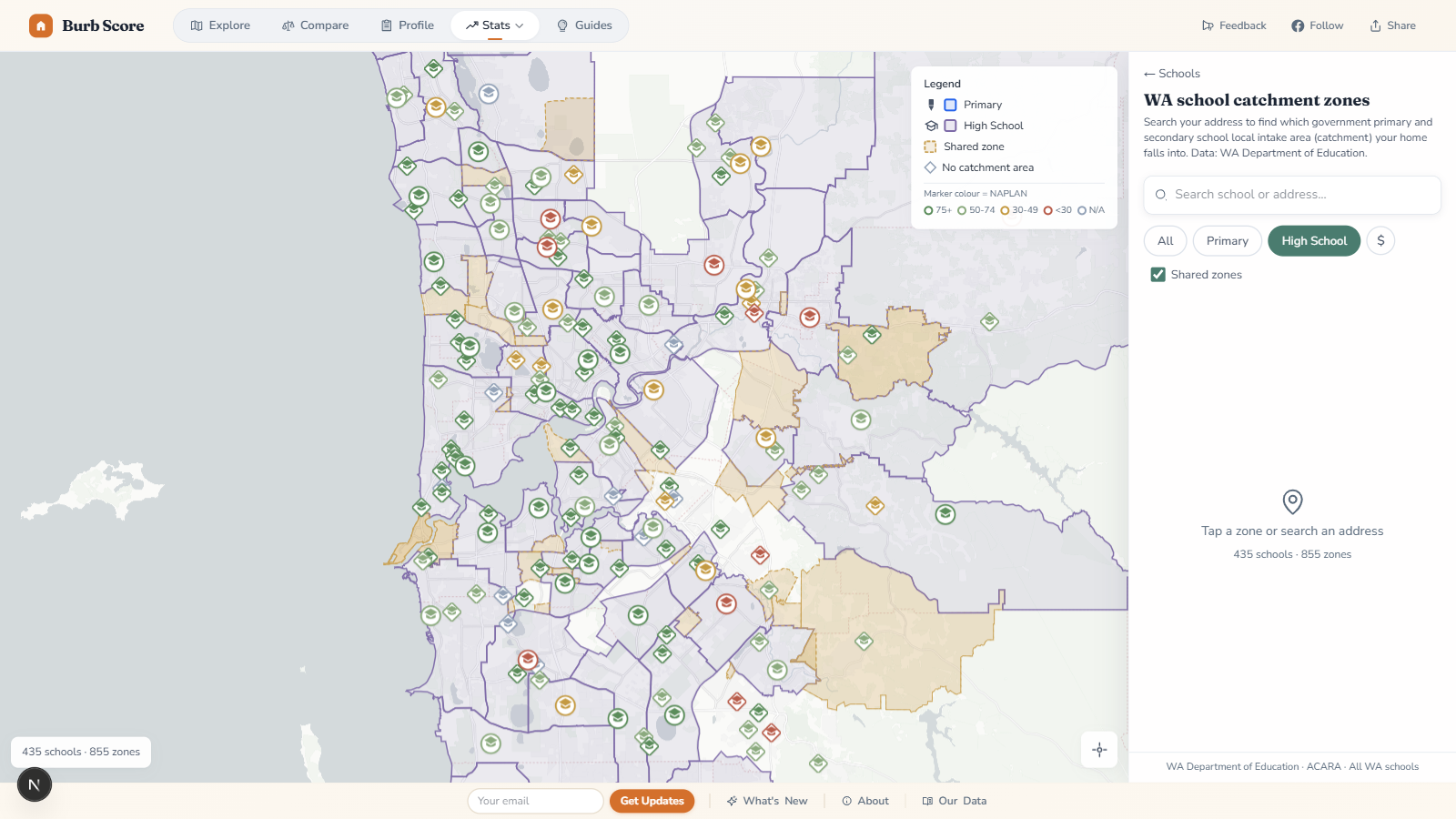
Open the live catchment map. Toggle primary vs secondary polygons to see how the boundaries differ for the same address.
This catches a lot of families out. Year K-6 polygons and Year 7-12 polygons rarely align. Some primary schools feed multiple high schools depending on which side of a road you live on. If you're choosing a long-term home, check both maps separately, being in a top primary's catchment doesn't guarantee you're in the equivalent high school's catchment.
| Question | Primary (K-6) | Secondary (7-12) |
|---|---|---|
| Boundary set | Independent | Independent |
| Typical size | Smaller, often a few suburbs or part of one | Larger, can span 5+ suburbs |
| Feeder relationship | One primary often feeds multiple high schools | One high school draws from multiple primaries |
| Address sensitivity | Usually stable across a street | Can flip on a single road or rail line |
| Selective/state-wide entry | None at primary level | Perth Modern (academic), John Curtin (arts), other GATE schools |
A worked example: in Floreat the secondary-school catchment is split by Cambridge Street. Homes north of Cambridge feed Churchlands SHS; homes south feed Shenton College. Floreat Park Primary School itself serves the whole suburb at primary level, but the secondary feeder depends on which side of one road you live on. Confirm by typing the exact address into the catchment map and switching the layer between primary and secondary.
Out-of-catchment enrolment, when it works
You can apply to enrol your child at a school outside your LIA. The Department of Education's Enrolment in Public Schools Procedures set out the rules. Two points worth knowing before you apply:
- In-catchment students always go first. Out-of-area applications only get considered after every resident inside the LIA has been offered a place. At chronically oversubscribed schools (Rossmoyne SHS, Willetton SHS, Shenton College, Mount Lawley SHS) the LIA fills the entire intake most years
- The Department's published priority order for out-of-area places: (1) students accepted into an approved specialist or gifted-and-talented program at that school, (2) applicants with a sibling already enrolled, ordered by proximity, (3) applicants without a sibling, ordered by proximity. Sibling priority is not a tiebreaker for in-area places, it only applies to the out-of-area pool
What this means in practice:
- Apply early. Most schools open applications in Term 2 for the following year. Submitting in the first weeks of the window does not improve your priority directly, but it does mean the school can respond before you commit to other arrangements
- Don't apply to multiple schools as a hedge. The Department asks families to apply to one preferred school first. Parallel applications can hurt your standing if a placement officer notices, and most schools share information with neighbouring catchments
- Get the sibling proof ready. If you're relying on sibling priority, the sibling must already be enrolled or have an accepted offer. Children-in-progress (a younger sibling not yet enrolled) do not count
- Specialist programs are the most reliable out-of-area pathway. Acceptance into an approved specialist program at the school takes top priority over sibling and proximity. For high schools, this typically means the Academic Selective Entrance Test (ASET) for GATE places, or audition/trial for sport, arts, languages, or music programs
- Have a real backup. If the out-of-area application is rejected, your child reverts to your LIA school. Make sure that school is one you're comfortable with before you put effort into chasing an out-of-area spot
Appeals and waitlists
If your out-of-area application is rejected, the principal will tell you in writing and outline the appeal pathway. Most appeals go to the Department's Regional Education Office and turn on whether the school correctly applied the priority order. A successful appeal usually requires evidence the school skipped your priority tier (for example, accepted an out-of-area applicant without a sibling ahead of an applicant with one). Compassionate grounds (medical, family separation, custody arrangements) can also be considered, but appeals on "this is a better school" alone almost always fail.
Waitlists exist for most popular schools. If you accept your LIA school but still want the alternative, ask to be added to the out-of-area waitlist. Movement happens through the first weeks of Term 1, when families who accepted multiple offers settle on one and free spots elsewhere.
Country WA and selective-entry schools
Outside the metro area, most public schools don't have a fixed catchment, enrolment is allocated by proximity to the school. Type a regional address into the map and you'll see no polygon overlay; the official Schools Online portal will return the nearest school instead.
The exception going the other direction is Perth Modern School, WA's only fully academically selective public high school. Entry is by the Department's Gifted and Talented test, and intake is state-wide, there's no Perth Modern catchment. Schools of Special Educational Need (SEN) work similarly.
Top-performing public schools by catchment
If you're using catchment information to choose where to live, the next question is which schools are worth optimising for. We rank Perth public schools by NAPLAN, with ICSEA and attendance shown alongside as context:
- Perth primary school rankings 2026, top 10 government primaries by NAPLAN performance
- Perth high school rankings 2026, top 10 government high schools by Year 9 NAPLAN performance
Both pages link back to the catchment tool so you can check whether the top schools are actually reachable from where you live (or are willing to move).
If you take one thing away
Don't trust generic catchment chatter from real estate agents. Type your exact address into the catchment map, boundaries follow streets, sometimes cross at unexpected angles, and the difference between two sides of a road can be the difference between Rossmoyne SHS and a school three positions down the ranking. Verify before you buy.
What this guide doesn't cover
Catholic and independent schools don't use the LIA system. Each runs its own enrolment policy, sibling priority, parish affiliation, religious denomination, application waitlists, fee tiers. If you're considering non-government schools, contact each school directly. The catchment map covers public schools only.
Data & methodology
The catchment polygons displayed are the official WA Department of Education local intake areas, scraped quarterly from the public Schools Online portal and the WA Department of Education's mapping endpoints. School-level statistics (NAPLAN, ICSEA, attendance, fees, enrolments) layered over the polygons come from ACARA / MySchool.
If a polygon looks out of date, the source has either redrawn it (boundaries shift occasionally, usually after a new school opens) or our quarterly refresh is mid-cycle. Confirm via Schools Online for the authoritative current answer.
Nick Lilleyman
Founder & Data Lead, Burb Score
Nick built Burb Score to give Perth families a data-driven view of where to live. He works directly with the ACARA, WA Police, ABS Census, WA Rental Bonds and real estate datasets that power every ranking on this site. Rankings are generated programmatically from official data sources, not opinions, and refresh automatically. No sponsored content or paid placements.
Frequently asked questions
What's the difference between a catchment and a local intake area?
In Western Australia, the official term is local intake area (LIA). Catchment is the common shorthand. They refer to the same thing, the geographic zone where a public school guarantees enrolment to resident children. The Department of Education uses LIA; everyone else says catchment.
Can my child attend a school outside our catchment?
Yes, you can apply, but you're competing for limited out-of-area places. Every in-catchment student is enrolled first. After that, the principal allocates remaining out-of-area places in this order: (1) students accepted into an approved specialist or gifted-and-talented program at the school, (2) applicants with a sibling already enrolled, ranked by proximity, (3) applicants without a sibling, ranked by proximity. Popular schools (Rossmoyne, Willetton, Shenton, Mount Lawley) regularly turn away out-of-area applicants because the LIA fills the intake. Apply early in the enrolment window.
Do private and Catholic schools have catchments?
No. Non-government schools run their own enrolment policies, sibling priority, parish affiliation (for Catholic schools), waitlists, religious or denominational criteria, and fee tiers. There is no government-imposed catchment. Contact each school directly for their admission rules.
How do I find my catchment by address?
Use the address finder embedded above, it opens the full WA catchment map zoomed to your home with the relevant polygon highlighted. Alternatively, the WA Department of Education runs Schools Online, the official portal, it returns the guaranteed-enrolment school for any WA address.
Are catchment boundaries the same for primary and secondary?
No. Primary (K-6) and secondary (7-12) LIAs are drawn independently. A primary school doesn't always feed the high school you'd geographically assume. Always check both maps, the catchment tool lets you toggle the layer.
Does living in a catchment guarantee a place?
For mainstream public schools, yes, being inside the local intake area guarantees enrolment regardless of the school's popularity. The guarantee is statutory. Selective-entry schools like Perth Modern are the exception: entry is by test, not address.
How often do catchment boundaries change?
Rarely. The Department of Education redraws LIAs occasionally, usually when a new school opens, an existing school closes, or rapid suburban growth makes a boundary impractical. When it happens, the change is announced via the school and the Department's website. Otherwise, boundaries can stay stable for years.
Where does the catchment data on this site come from?
Catchment polygons are sourced from the WA Department of Education's public mapping endpoints, refreshed quarterly. School statistics (NAPLAN, ICSEA, attendance, fees, enrolments) come from ACARA / MySchool. We list our methodology in the data and methodology section above.
Continue your research