Rankings refresh automatically from live data
Perth's Most Bushfire-Prone Suburbs, Ranked by DFES Data
There's a version of this list you might expect: remote outposts on the rural fringe, the places people end up rather than choose. The actual top ten reads like a Perth Hills lifestyle brochure, with median house prices running from about $870,000 to $1.9 million. These are some of the most sought-after addresses in the metro area, and every one of them is effectively 100% bushfire prone under the official DFES designation.
That's the tension at the heart of this ranking. The things that make these suburbs desirable (jarrah forest at the back fence, escarpment views, acreage blocks under marri and wandoo) are precisely what puts them on the Fire and Emergency Services Commissioner's Map of Bush Fire Prone Areas. The bush isn't an unfortunate side effect of the location; it's the entire value proposition. People aren't buying here despite the bush. They're paying a premium for it.
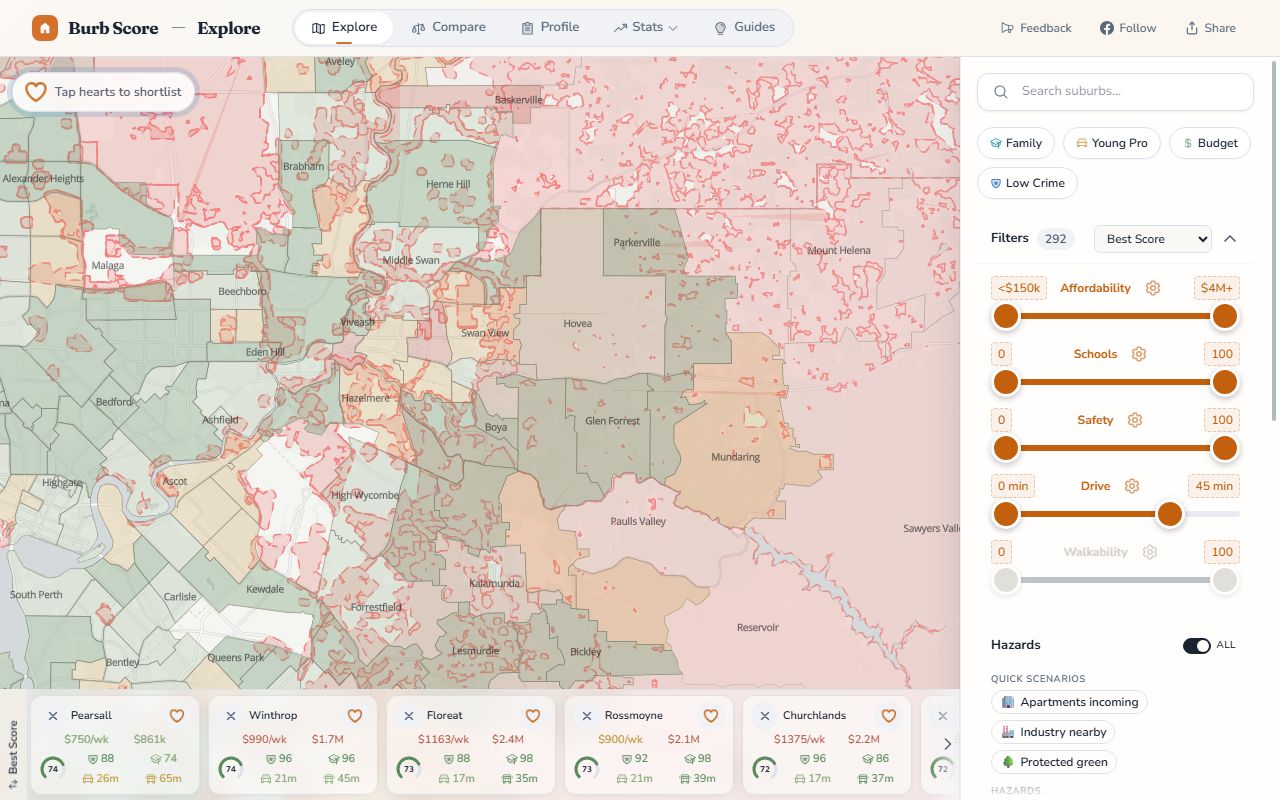
Bushfire prone areas (DFES) on the BurbScore map, Perth Hills. Click to open the live layer.
Why the Perth Hills dominate this list
The pattern is unmistakable. Eight of the ten sit along the Darling Scarp in the Shires of Mundaring and Kalamunda, the classic Perth Hills belt anchored by Gooseberry Hill at its northern end, all between 99.5% and 99.9% covered. The remaining two are rural-residential suburbs on the south-eastern fringe in the Serpentine-Jarrahdale corridor, where large lots back onto paddocks and remnant bushland rather than state forest. Two different landscapes, one common feature: the vegetation isn't an amenity bolted onto the suburb, it is the suburb.
Three standouts deserve a closer look. Lesmurdie is the one that should recalibrate your mental image of "bushfire prone": 8,400 residents at 99.6% coverage. That's not a hamlet in the trees; it's a full suburban community with schools, shops and a national park waterfall, where essentially every property carries the designation. Darlington (3,725 people, 99.7%) is the hills' cultural heart, a federation-era arts village that regularly tops liveability conversations. And it is, to within a rounding error, entirely bushfire prone. Finally, Cardup is the only suburb in our top ten at a perfect 100.0%: every square metre of it is designated, and its median house price is still around $1.7 million.
What does living in a bushfire prone area actually require?
If you build new or substantially renovate, you'll need a Bushfire Attack Level (BAL) assessment, and anything rated above BAL-Low must be built to the AS 3959 construction standard. Existing homes face no retrofit mandate, but expect insurance to price in the risk, and you'll need a genuine bushfire plan each summer.
Here's how the machinery works. The Fire and Emergency Services Commissioner designates bushfire prone land by order under the Fire and Emergency Services Act 1998, and that designation is what triggers everything else. A new habitable building, or a major renovation, inside a designated area requires a BAL assessment by an accredited assessor, who scores the site on vegetation type, slope and distance to classified vegetation. The result is one of six ratings, from BAL-Low up through BAL-12.5, 19, 29 and 40 to BAL-FZ (Flame Zone).
That rating dictates real construction requirements under AS 3959: ember-resistant screens, sealed eaves, toughened glass, non-combustible decking, and at the top ratings, bushfire shutters and specialised glazing systems. The cost impact is not theoretical: industry estimates put the jump from BAL-19 to BAL-40 at $30,000 or more, and a BAL-FZ build can add six figures to a standard home. Developments rated BAL-40 or BAL-FZ can also need planning approval on top of a building permit.
None of which makes this a do-not-buy list. More than 25,000 people live happily in these ten suburbs and most wouldn't trade the trees for anything. It's a know-what-you're-signing-up-for list: get insurance quotes before you make an offer, budget honestly for BAL construction if you're building, and have an evacuation plan you'd actually follow. If you're weighing several hills suburbs against each other, you can compare them side by side on crime, schools and prices before you fall for the trees. For context, 410 of the roughly 1,600 WA suburbs in our dataset contain at least some bushfire-prone land, so the designation itself is common. What's rare about these ten is the totality.
Cardup
Cardup is a quiet, semi-rural pocket tucked into Perth's southern fringe near Byford and Mundijong. Acreage blocks and open space define the lifestyle here, it's the kind of place people move to for room to breathe, not for cafes or nightlife. Bushfire risk is real, services are minimal, and the commute to Perth is long, but new rail infrastructure is creeping closer and the southern growth corridor keeps expanding.
Gooseberry Hill
Gooseberry Hill is a quiet, heavily treed hills suburb best known for its spectacular Perth city lookout and the famous Zig Zag scenic drive. Life here revolves around nature: bushwalking, outdoor recreation, and watching the city lights spread out far below. It is deeply car-dependent and far from urban conveniences, but for those seeking a genuine tree-change in an established, close-knit community, the tradeoff feels worthwhile.
Glen Forrest
Glen Forrest is a quiet Perth Hills suburb defined by its bush setting and laid-back character. Residents are firmly car-dependent: cycling or commuting without a car requires parking at Midland and riding from there. Infrastructure can be unreliable, with NBN and water outages frustrating locals, but the trade-off is a nature-rich lifestyle with the Mundaring sculpture park and hills scenery close by. It attracts those who value space and greenery over urban convenience.
Oakford
Oakford is a quiet acreage suburb on Perth's southern rural fringe, where residents keep horses and livestock on large blocks and value genuine separation from city life. It sits deep in bushfire country, with car dependency absolute and infrastructure stretched: power and mobile coverage can vanish together in an emergency. For those who want space, silence, and a country feel within reach of the city, Oakford delivers, but urban conveniences are a significant drive away.
Hovea
Hovea is a quiet, bush-clad enclave in the Perth Hills sitting on the edge of John Forrest National Park. Life here revolves around trails, waterfalls, and native bushland, drawing hikers and nature lovers rather than urban professionals. The historic Swan View tunnel adds a layer of intrigue. Bushfire risk is real and ever-present, and the suburb offers almost no urban amenities, making it a place for those who genuinely want to live in the bush.
Bickley
Bickley is a quiet semi-rural retreat in the Perth Hills, centred on the scenic Bickley Valley. It is best known for the Perth Observatory, vineyards like Hainault, and Core Cider House, making it a popular day-trip destination rather than a suburb people move to for convenience. Cyclists seek out its challenging hill roads, and the cool microclimate and orchard landscapes give it a distinctly unhurried, nature-immersed character far removed from suburban Perth.
Darlington
Darlington sits high on the Darling Scarp with sweeping views across Perth's coastal plain, drawing those who value bush living over urban convenience. The suburb has a distinct character, eclectic, creative, community-minded, with the long-running Darlington Arts Festival and neighbourhood bonfires reflecting a tight-knit local identity. The trade-off is real: bushfire risk and distance from city services, but for residents, the natural beauty and community make it worthwhile.
Lesmurdie
Lesmurdie sits on the edge of the Darling Scarp and is defined almost entirely by its extraordinary natural setting. The falls and surrounding national park draw hikers, photographers, and wildlife watchers year-round, with sunrise views over Perth earning genuine awe. It is quiet, established, and firmly car-dependent — a hills suburb where community warmth runs high and the pace of life is deliberately unhurried.
Check any address before you buy
Suburb-level percentages are the starting point, not the answer. The designation applies at lot level, and within a 99%+ suburb the practical risk still varies street by street with vegetation and slope. Turn on the bushfire layer on our Explore map to see the designated areas across all of Perth, or open any suburb page with the hazard overlay active. Lesmurdie and Darlington are good places to see what near-total coverage actually looks like on a map: not a hatched corner of the suburb, but the entire polygon. For a formal lot-level answer, DFES publishes the official Map of Bush Fire Prone Areas with an address search, and that current version (not last year's) is what determines whether a BAL assessment applies to your build.
Bushfire is one layer of several
If you're doing due diligence on a property, bushfire designation should sit alongside flood risk, aircraft noise and planned developments. We've covered the full checklist in our guide to checking property hazards in Perth. And if the hills' bush premium isn't your trade-off, it's worth knowing that flatter, quieter-looking suburbs carry their own overlays: see our ranking of Perth's most flight-path-affected suburbs for the airborne equivalent of this list. Every hazard layer tells the same story in a different key: the data is public, the patterns are stable, and ten minutes of checking before an offer beats finding out at the building-permit stage. The buyers who do best in these suburbs aren't the ones who avoided the designation; they're the ones who priced it in from the start.
Data & methodology
Ranked by the percentage of each suburb's land area that intersects the DFES Map of Bush Fire Prone Areas, the statutory designation made by order of the Fire and Emergency Services Commissioner under the Fire and Emergency Services Act 1998. We sourced the designated-area polygons via Landgate's Shared Location Information Platform (SLIP) and computed the spatial intersection with suburb boundaries in our database.
Only Perth metro suburbs with population over 500 are included, which excludes unpopulated forest blocks that would otherwise fill the list. Of roughly 1,600 WA suburbs in our dataset, 410 contain at least some bushfire-prone land. Figures are current as of June 2026; DFES generally updates the map annually, so lot-level designations should always be confirmed against the current official map.
Nick Lilleyman
Founder & Data Lead, Burb Score
Nick built Burb Score to give Perth families a data-driven view of where to live. He works directly with the ACARA, WA Police, ABS Census, WA Rental Bonds and real estate datasets that power every ranking on this site. Rankings are generated programmatically from official data sources, not opinions, and refresh automatically. No sponsored content or paid placements.
Frequently asked questions
What is a BAL rating?
A Bushfire Attack Level (BAL) measures a building's potential exposure to ember attack, radiant heat and direct flame contact. An accredited assessor scores the site on vegetation type, slope and distance to classified vegetation, producing one of six ratings: BAL-Low, BAL-12.5, BAL-19, BAL-29, BAL-40 or BAL-FZ (Flame Zone). The rating determines which construction requirements of AS 3959 apply to a new build or major renovation.
Does a bushfire prone designation affect insurance?
Generally yes. Insurers price location-based bushfire risk into premiums, so homes in designated areas typically cost more to insure, and some insurers are reluctant to cover properties at the highest ratings (BAL-40 and BAL-FZ). Premium discounts for risk-reduction work are rare. Get insurance quotes for a specific address before you make an offer, not after.
Can I still build in a bushfire prone area?
Yes. The designation regulates how you build, not whether. New habitable buildings need a BAL assessment, and anything above BAL-Low must meet the AS 3959 construction standard, which adds cost (a jump from BAL-19 to BAL-40 can add $30,000 or more). Development assessed at BAL-40 or BAL-FZ can also require planning approval on top of a building permit, with some exceptions for single dwellings on smaller lots.
How often is the DFES map updated?
DFES generally updates the Map of Bush Fire Prone Areas every year to improve its accuracy and currency. Each version is designated by order of the Fire and Emergency Services Commissioner under section 18P of the Fire and Emergency Services Act 1998. The most recent came into effect on 13 December 2025. Always check the current official map for a specific lot before buying or building.
Does "bushfire prone" mean a fire is likely at my address?
No. The designation means the land has the potential to be impacted by bushfire, based on proximity to bushfire-prone vegetation: it is an exposure classification, not a prediction. Within a 99%+ designated suburb, practical risk still varies street by street with vegetation, slope and access. It's a trigger for building standards and a prompt for planning, not a forecast.
Explore these suburbs further