Rankings refresh automatically from live data
Perth Flight Path Suburbs: Aircraft Noise Ranked by ANEF
“Can you hear the planes?” is one of the most-asked questions about Perth suburbs, and one of the least-quantified. Ask on a forum and you'll get anecdotes: someone near the airport who “barely notices”, someone two suburbs over who swears the windows rattle at 6am. Both can be true, because aircraft noise exposure is mapped, measurable, and varies street by street. So we put numbers on it: every Perth metro suburb, ranked by its exposure under the official ANEF aircraft noise contours for Perth Airport and Jandakot Airport.
ANEF stands for Australian Noise Exposure Forecast. It's the measure Australian land-use planning actually runs on: airports model their forecast operations (every arrival and departure, weighted by loudness, frequency and time of day, with night flights counting extra) and publish contour maps in bands of 20, 25, 30, 35 and 40. The charts are endorsed by Airservices Australia and baked into planning policy, including WA's State Planning Policy 5.1 covering land around Perth Airport. An ANEF value isn't the decibel reading of a single flyover; it's a forecast of the cumulative annual noise load over a location.
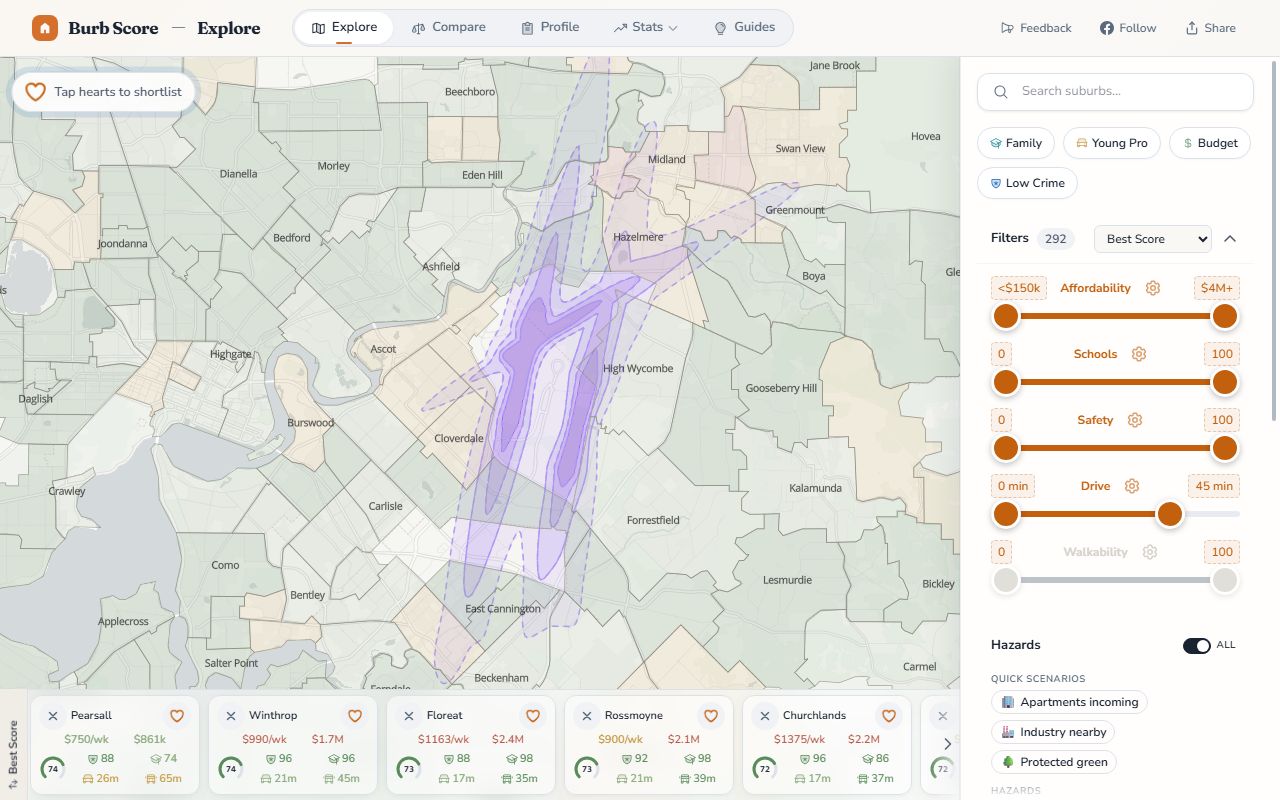
ANEF contours for Perth Airport over the eastern corridor. Click to open the live layer.
What ANEF level is too noisy for a house?
Under Australian Standard AS 2021, land below 20 ANEF is acceptable for new houses. Between 20 and 25 is conditional: new homes should be designed with noise attenuation such as acoustic glazing and insulation. Above 25 ANEF, new residential development is generally considered unacceptable, though plenty of existing housing predates the contours.
That last point is the key to reading this ranking. Most of our top ten have established residential streets inside the 25 or 30 contour: homes built before modern planning controls, in locations today's rules would knock back for a new subdivision. Living in them is entirely legal and, for thousands of Perth households, entirely normal. But it's worth knowing before you buy, because retrofitting acoustic treatment is far more expensive than building it in, and the contour band tells you what AS 2021 thinks that street needs.
Two corridors, two airports
The ranking traces two clear shapes on the map. The first is the Perth Airport eastern corridor: a heritage strip along the Swan to the north of the runways, and an older industrial-residential belt to the airport's south-west. Eight of the ten most-exposed suburbs sit in this corridor. The second is Jandakot Airport, one of Australia's busiest general-aviation airfields, whose constant circuit-training traffic generates the other two entries on its own contours.
A few standouts. Jandakot tops the table at ANEF 40 across two-thirds of the suburb, but most of that footprint is the airfield itself plus surrounding industrial estates, with only around 2,500 residents. High Wycombe is the more confronting result: over 12,000 people, with nearly a third of the suburb inside the ANEF 35 band off the end of Perth Airport's main runway. That's the highest forecast exposure of any genuinely populous suburb in WA. Canning Vale is the surprise entry: 34,500 people make it one of Perth's biggest suburbs, yet only 12% of its area touches the ANEF 30 contour on the Jandakot side. There, exposure depends entirely on which street you're on: the eastern fringe near the airfield is a different acoustic world from the suburb's western half. And Guildford shows what the corridor's northern end looks like: 77% of the suburb inside the ANEF 25 contour. Heritage streetscapes and federation cottages, with a soundtrack.
There's a flip side, and it's the reason these suburbs keep attracting buyers: price. The flight-path corridor offers some of the most affordable established housing within easy reach of the CBD, the Swan Valley and the airport itself, precisely because the noise is already priced in. For FIFO workers, frequent flyers, or anyone who genuinely tunes it out, that discount is real value, as long as it's an informed trade.
Perspective helps too: of the roughly 1,600 WA suburbs in our dataset, only 35 intersect any ANEF contour at all. For the overwhelming majority of Perth, the forecast aircraft noise exposure is simply zero. You can confirm any address yourself on the BurbScore aircraft noise map. Here are the ten suburbs where it isn't zero.
Jandakot
Jandakot sits at the edge of Perth's southern suburban frontier, part quiet residential estate, part industrial hub, part nature reserve. The beloved Spud Shed draws bargain hunters from across the south, the Regional Park offers misty-morning escape, and the Gleniris estate is pulling in families chasing space. Car-dependent and airport-adjacent, it rewards practicality over polish, a suburb in transition as urban infill and rising land values reshape its identity.
High Wycombe
High Wycombe sits on Perth's eastern fringe, wedged between the airport and the Darling Scarp foothills. The Airport Line train station transformed commute times and property prices have surged on the back of it. Bushfire risk is real, with emergency-level events in 2021 and 2026 drawing out genuine community solidarity. Crime headlines crop up regularly, and the suburb's limited road connections make it feel isolated when things go wrong.
South Guildford
South Guildford appeals to buyers seeking larger, established blocks at relatively affordable prices in a quiet, semi-rural setting. The trade-offs are real: aircraft noise from nearby Perth Airport and Swan River flood risk are recurring concerns. New builds must meet noise insulation requirements. The suburb suits those wanting space and greenery rather than walkable urban convenience.
Kewdale
Kewdale is an affordable, established suburb straddling the residential and industrial worlds near Perth Airport. Tomato Lake draws locals for walks and photography, and tight-knit streets around Kewdale Primary have real community spirit. The trade-off is a suburb that wears its mixed-use zoning plainly, with freight corridors, airport proximity, and a patchy safety reputation.
Cloverdale
Cloverdale is an affordable, established suburb in Perth's eastern corridor, sitting a short drive from the CBD and even closer to the airport. It's a multicultural community with a strong local identity — long-running businesses, friendly neighbours, and Christmas light trails speak to genuine community spirit. Safety concerns are real and street-dependent, but the area is clearly on an upward trajectory, with newer builds and rising buyer interest signalling slow but steady gentrification.
Canning Vale
Canning Vale is a large, sprawling south-of-the-river suburb that locals see as an affordable, multicultural family area with solid shopping options and a beloved Sunday market. The food scene punches above its weight, especially for Vietnamese and South Asian cuisine. However, it is heavily car-dependent with notoriously bad traffic around Nicholson Road, and parts near the industrial zone and prison feel less desirable. Young people often note there is not much to do for entertainment, and petty crime occasionally makes headlines.
Queens Park
Queens Park is an affordable, working-class suburb just south of Cannington, popular with multicultural families and budget-conscious buyers. Two train stations and proximity to Carousel shopping centre give it reasonable connectivity. Crime is a persistent concern, with regular reports of break-ins and antisocial behaviour, though major infrastructure upgrades including elevated new train stations signal gradual investment in the area.
Guildford
Guildford is Perth's most historically significant suburb, a colonial-era townsite with pubs, pottery studios, antique strips and riverside reserves that feel genuinely old-world. Community spirit runs deep here, from Medieval Fayres at Stirling Square to campaigns saving century-old trees. The vibe is established and arts-leaning rather than slick or modern, with South Guildford offering large blocks at reasonable prices, though aircraft noise and the fading antique trade are real trade-offs.
Hazelmere
Hazelmere sits on Perth's eastern fringe as a working industrial suburb, home to freight depots, a tallow factory, and heavy rail. Semi-rural pockets still host alpacas and poultry farms, but the suburb is best known to outsiders for factory smells and train noise. New housing releases are nudging it toward residential, though buyers should factor in flight paths and industrial neighbours before committing.
Caversham
Caversham is a fast-growing outer suburb on the edge of the Swan Valley, popular with young families drawn by affordable new estates and the rural feel of the area. It is firmly car-dependent with limited public transport, but residents enjoy easy access to wineries, nature trails, and the river. Safety concerns and a lack of urban amenities are the main trade-offs in what remains a suburb still finding its identity.
Check the street, not the suburb
The single most important caveat in this ranking: ANEF exposure is street-level, not suburb-level. A suburb ranked here by its maximum contour band can have whole neighbourhoods with no forecast exposure at all. Canning Vale is the textbook case, and even Cloverdale's 30 band covers less than a third of the suburb. Before you cross a suburb off (or commit to one), turn on the aircraft noise layer on the Explore map and look at where the contour actually falls relative to the streets you're considering. Every suburb page carries the same panel; see High Wycombe for the starkest example of a contour slicing a populated suburb in two.
Forecasts, not recordings
Remember what ANEF is: a forecast of cumulative future noise based on planned operations, not a microphone reading. You can hear aircraft well outside the 20 contour (especially under departure tracks), and Perth Airport's new parallel runway will redistribute traffic from 2028, which is already reflected in the current composite contours. Treat the bands as the planning system's best estimate of where noise will be a design consideration, then trust your own ears at an inspection: visit at different times of day, and on a weekday when Jandakot's circuit training is busiest.
Aircraft noise is one of five hazard layers we map. For the full picture (flood, bushfire, road and rail noise, and planned developments) see our guide to checking every hazard on a Perth property, or jump straight to the companion ranking of Perth's most bushfire-prone suburbs. And if you're weighing a flight-path discount against everything else a suburb offers, you can compare suburbs side by side on crime, schools, rent and prices.
Data & methodology
Suburbs are ranked by the maximum ANEF contour band intersecting the suburb, with the percentage of suburb area inside any ANEF contour shown for context. Contours are the published Australian Noise Exposure Forecast charts for Perth Airport and Jandakot Airport, produced by the airports under their master plans and endorsed by Airservices Australia. We sourced them via Landgate's Shared Location Information Platform (SLIP) and spatially intersected them with ABS SAL 2021 suburb boundaries in our database.
Only Perth metro suburbs with population > 500 are included. Of the ~1,600 WA suburbs in our dataset, just 35 intersect any ANEF contour. A suburb's ranking reflects its worst-exposed land, not a uniform suburb-wide noise level. Check the contour position on the map for any specific address. Data current as at June 2026.
Nick Lilleyman
Founder & Data Lead, Burb Score
Nick built Burb Score to give Perth families a data-driven view of where to live. He works directly with the ACARA, WA Police, ABS Census, WA Rental Bonds and real estate datasets that power every ranking on this site. Rankings are generated programmatically from official data sources, not opinions, and refresh automatically. No sponsored content or paid placements.
Frequently asked questions
Does aircraft noise affect property values?
Generally yes: Australian and international studies consistently find homes inside high ANEF bands sell at a discount compared to equivalent homes outside them. In Perth's established flight-path suburbs that discount is largely already capitalised into prices, which is exactly why the eastern corridor ranks among the more affordable inner-ring options. The risk is paying a no-noise price for a high-noise street, so check the contour before you bid.
Can I build a house in an ANEF 25 zone?
Under AS 2021, land between 20 and 25 ANEF is conditionally acceptable for houses: new dwellings should incorporate noise attenuation such as acoustic glazing, insulation and sealed construction. Above 25 ANEF, new residential development is generally considered unacceptable. Around Perth Airport, State Planning Policy 5.1 puts additional controls on subdivision and development in noise-affected areas, so always confirm requirements with your local government and the WA Planning Commission before buying land to build.
Are ANEF contours the same as actual flight paths?
No. ANEF contours are a forecast of cumulative annual noise energy: loudness, frequency and time of day averaged over a year of planned operations. Actual flight paths spread far wider than the contours, which is why you can clearly hear aircraft in suburbs that intersect no contour at all. The contours mark where noise is significant enough to constrain land use, not the only places planes are audible.
Will Perth Airport's new runway change the contours?
It already has. Contractors for the new parallel runway were appointed in late 2025, construction is underway from early 2026, and operations are planned from 2028. Perth Airport's current ANEF is a composite that models those future parallel-runway operations, endorsed by Airservices Australia. The airport expects most residents' exposure to fall as movements spread across two runways, but some areas will see more noise and some will be newly affected. The contours in our data reflect that future-operations forecast.
Why isn't my suburb listed when I hear planes all the time?
Audibility and ANEF exposure are different things. Only 35 of the ~1,600 WA suburbs in our dataset intersect any ANEF contour. The bands capture sustained, planning-significant noise near the airports, not every suburb under a departure track. If you can hear aircraft but your suburb isn't here, your forecast noise load sits below the ANEF 20 threshold that triggers building and land-use controls.
Explore these suburbs further